
I got some people mad at me on Facebook this week. Yeah, again.
I promise it wasn’t intentional. Once again, I’m a pacifist, I swear! It’s just hard for me to keep my (virtual) mouth shut when I see folks spreading verifiably false claims. Chalk it up to me caring when people believe things that just aren’t true, which probably leads me into all kinds of conflicts. Just ask my wife, who is infinitely patient with me, no matter what. If I have to have character flaws, call this insistence on the truth one of them.
(If you’re not mad at me yet, just wait until I write a newsletter about the fact that the moon has zero impact whatsoever on human behavior—but that’s a topic for another week.)
What was the source of the strife? Well, a local restaurant posted “We have some exciting news, or at least we think it is! We are going to give beef tallow a shot. We are excited for this simply because it’s been shown to be a bit healthier than seed oils, and there’s the added benefit of the flavor and a better fry on the items we are making in the fryers. (they followed this with a bunch of hashtags, including #health and #food). No need to call the specific restaurant out here, since they’re just as much a victim of this false information as anyone else. I’m not mad at the restaurant, just at those who don’t realize how wrong they are. After seven hours, this post had 598 reactions, with four sad reacts and one angry one. That gives you some sense of just how many people believe this preposterous idea.
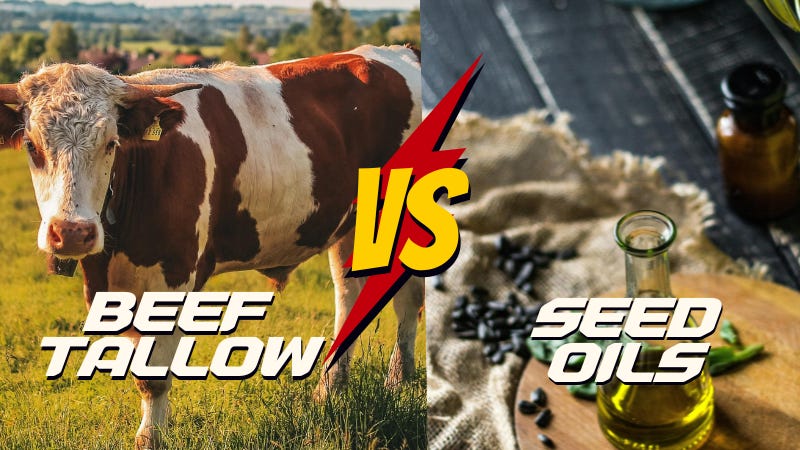
Let’s tackle a few elementary things right up front. Why am I immediately grumpy about this post? A few reasons:
The biggest proponent of using beef tallow rather than seed oils as of late has been RFK Jr., who made it a central part of his presidential campaign and now his Make America Healthy Again initiative within the current administration. Anything that man says deserves a healthy dose of scrutiny.
Wellness influencers have also been peddling the ridiculous idea that beef tallow is “healthy” for several years, and most of them are desperately trying to make money by any means necessary. Why would you believe anyone whose main motivation is getting rich off you and your credulity?
The whole idea of Make America Healthy Again as a “movement” has been focused around pseudoscience, misinformation, and the concept of an “obesity epidemic”, which may or may not even exist.
Anti-fat bias is a very real issue, and stigma around those with bigger bodies is not easy to navigate. Nobody should willingly contribute to (and worsen) this attitude.
Seed oils most likely offer some pretty positive benefits to our health.
Beef tallow most likely has a lot of negative effects on our health.
So much of the dialogue around this topic relates to “chemicals” and “processed food”, which is just another form of anti-science hysteria. EVERYTHING IS MADE FROM CHEMICALS.
There are all kinds of things that are deeply wrong with our current food infrastructure, and frying stuff in any kind of oil isn’t good for us—but there are many more issues with fast food (and some processed food) that are far worse for us than the oil it contains.
So where did this idea even come from? Here’s an interesting Wikipedia article on Seed Oil Misinformation that might benefit you in your journey related to this particular rabbit hole.
As that Wikipedia article shows, the conversation around seed oils being bad for us started around 2018 or so, and increased dramatically after Joe Rogan did a highly-publicized interview with scam artist Paul Saladino (a psychiatrist who loves to assert things which have been disproven over and over and over again). Go here for a great science-based rebuttal of Saladino’s claims on the topic of seed oils. Wikipedia quotes Saladino as saying that “seed oils are the root cause of most diseases of affluence, including heart disease, cancer, diabetes, and liver spots”. I’ll bet you didn’t realize that’s where your liver spots came from! (Sorry, spoiler alert, it’s not. Liver spots actually typically come from exposure to the sun, and have nothing to do with your liver, as you can see in this article from the Cleveland Clinic).
What are seed oils? They’re most commonly defined as canola oil, corn oil, cottonseed oil, grapeseed oil, rice bran oil, safflower oil, soybean oil, and sunflower oil. Folks who believe in this nonsense commonly tend to call them “The Hateful Eight”, which IS the title of a fun Tarantino movie but is NOT a term that I plan to use anytime soon to describe ingredients in my kitchen cabinets.

One primary claim made by anti-seed oil people is that the extraction process used to make these oils leaves behind toxic byproducts (primarily hexane) in the oil itself. Basically, it used to be really expensive to mechanically crush whatever you were trying to squeeze oil out of, which meant that products with oil in them cost more. In the 1980s, hydrogen gas was used to squeeze the corn or soybeans (which created cheap oil, but were high in trans fats). If you’ve heard about hydrogenated oils, that’s where that term came from. Those trans fats raise our LDL cholesterol levels (which we don’t want). So after that, most oil producers began using liquid hexane to squeeze the seeds instead, and then burning off the hexane so that the oil was left behind. Those hexane-extracted seed oils have very few trans fats, which is a good thing.
Since hexane gas is toxic, and since nobody accused wellness influencers of knowing the difference between a liquid and a gas, they claim that oil derived from this process is toxic as well. Any studies that show that is causing a problem for people are either tiny or inconclusive, though. And both Europe and the US have done extensive studies and determined that this is not a huge matter of concern, since any hexane that actually enters our systems this way is a miniscule amount. So that’s claim number one: fear about hexane. I’d also point out that, ironically, some of the same wellness influencers that tell you hexane extraction makes seed oils toxic are simultaneously selling their own fish oil products to you that are made with the same hexane process.
Claim number two is about omega-6 fatty acids, and this is a fascinating one. Wellness folks tend to claim that these cause “inflammation” (which is a catch-all term that many things get blamed for by well-meaning non-scientists). As this excellent article points out, omega-6 fatty acids boost our good cholesterol (which, again, we want to have happen) . There has been some research that shows a correlation between a long-term diet containing a lot of omega-6s causing some intestinal inflammation, when compared to diets that include a lot of palm oil. This finding has resulted in the anti-seed oil people claiming that all seed oils do this, and that we need to stop the imbalance in our diets between omega-6s and omega-3s (which seem to help inflammation). But as the article goes on to point out, “Our body metabolizes omega 6s into all kinds of things--some inflammatory, some actually anti-inflammatory and health-protective”. It’s complicated! Generalizing these findings across a huge category of oils has no scientific basis, though.
Sarah Williams describes the complication around blaming it on inflammation in this piece, where she writes, “For decades, Gardner has hoped to find links between diet and inflammation but he said the immune system is still too poorly understood to make these kinds of associations when studying humans. So he is immediately skeptical of claims that seed oils cause inflammation — the body’s natural immune response to injury, infection or stress. His skepticism, he said, comes largely from the fact that there is no single test a doctor can order that fully captures the concept of inflammation.
“Measuring inflammation with any current laboratory tests is incredibly complex and just can’t be done yet,” he said. “There are hundreds of immune markers, and we really don’t know which ones are signs of a healthy immune system.”
Because there is a lack of agreement on what the best metrics for inflammation are, and a poor understanding of what types and levels of inflammation are appropriate for a healthy immune system, Gardner said it is inappropriate for any food — whether seed oils, omega fats, or something else — to be unquestionably dubbed anti- or pro-inflammatory.“
Allison Kane, from Massachusetts General Hospital, writes,
“Critics of seed oils propose that the omega-6 fatty acids found in seed oils are the cause of chronic inflammation. The reasoning is that linoleic acid, the most common omega-6, is converted into arachidonic acid in the body, which is a building block for compounds that cause inflammation. While this may sound convincing, a 2017 meta-analysis of randomized control trials found that increased dietary intake of linoleic acid does not have a significant effect on blood concentrations of inflammatory markers. This is likely because only a small percentage, about 0.2%, of omega-6s is converted to arachidonic acid. What many anti-seed oil influencers also overlook is that arachidonic acid is also a precursor for compounds that fight inflammation in the body. Many studies, including 2023 research in the International Journal of Molecular Sciences, show a higher intake of omega-6 fatty acids is associated with better cardiovascular health and improved glucose metabolism. The American Heart Association also supports the inclusion of omega-6s as part of a healthy diet to prevent cardiovascular disease.”
And the “ratio” argument doesn’t make any sense, either. In this piece from Johns Hopkins, Aliza Rozen writes, “A lot of discussion about seed oils focuses on a purported imbalance of omega-3s and omega-6s in most modern diets, which are heavier in grains and seeds compared to those of early humans. Some influencers claim that our consumption of omega-6s far outweighs that of omega-3s and that we should aim for a 1:1 ratio. The evidence does not bear this out.”
For those of you who say we need more omega-3s and fewer omega-6s in our diet, you know what’s an awesome source of omega 3s? Canola oil. How about that.
The third claim MAHA folks make about seed oils is that they provide “empty calories”. But again, Nargi writes, even advocates of swapping out fruit oils from avocado, olive, coconut and palm oil admit that no supply chain exists that would make this possible on a large-scale level. I think this quote from dietician and podcast host Jessica Wilson sums up the impracticality of that approach: “People are already stealing formula because they need it and it’s expensive. Making it more expensive with avocado oil or olive oil is terrifying to me.”
And the fourth big claim regarding seed oils relates to volatile compounds called aldehydes, which MAHA advocates believe are toxic. Unfortunately for this claim, studies that show issues with aldehydes (especially around cardiovascular problems and cancer) focus on us inhaling aldehydes, not eating them. There isn’t enough evidence to show that this is a huge issue on its own.
The truth is, our bodies are incredibly complex. The interplay between all the different things we eat and how they’re metabolized is impossible to break down and pin on any one thing. Our supply chain is also incredibly complex, and focusing on this one ingredient doesn’t make a whole lot of sense.
Most food that we eat contains some amount of seed oils, since they’re cheap to produce. And yes, our current food industry includes a lot of options that are cheap to produce and aren’t especially healthy for us. But the biggest issue with that food is the system itself, which can make it much more difficult for those with fewer resources to eat healthier, in addition to all the calories and fat and other not great ingredients the food contains (not to mention the environmental issues caused by this capitalistic food system of ours).
Sarah Williams (again, in her piece for Stanford) writes,
“The rise in seed oil use and consumption has paralleled increases in obesity and chronic disease. But Gardner said this correlation could be caused by other factors. Diets high in ultra-processed foods, for instance, are associated with cardiovascular disease, diabetes, and many other health conditions, and these ultra-processed foods often contain seed oils. Research has suggested that these associations are best explained by the presence of additives, sugar and sugar substitutes, nitrates, and overall nutrient profiles of ultra-processed foods.
“It’s true that we eat more ultra-processed junk food than we ever have before,” he said. “But the evidence is clear that the harms of this kind of food have more to do with their calories and their high amounts of added sugar, sodium and saturated fat than with seed oil.”
Illustrating this point, Nargi quotes James Curley, who writes The Natural Foods Geezer, saying he’s most concerned about
“the industrialized food system that’s delivering alarming rates of pesticide exposure, poor dietary choices for under-resourced people, and wholesale environmental degradation. He offers an analogy using tomatoes — one organic, one conventional. “People are like, which one is better? And I’m like, the organic tomato,” he says. “Why, is it higher in Vitamin C? No. Is it higher [in] lutein? No. Is it higher in antioxidants? No. Why is it better? Because this organic tomato was grown in a system that puts something back into the system, into the soil, into the preservation of tomatoes for my great-grandchildren. The other tomato was grown in an extractive environment where nothing is put back.”
So yes, of course, our food can leave a lot to be desired. Not necessarily because it’s processed or “ultra-processed”, though—there are many foods which are minimally processed which aren’t healthy for us. And processing doesn’t make it unhealthy for us. Let’s use more critical thinking skills than that, shall we? Here’s a good article that touches on a lot of my concerns about “ultra-processed foods”, which is, again, a topic for a whole different newsletter. We also haven’t discussed how complicated introducing more beef tallow makes eating out for vegans and vegetarians, either.
But moving on, if some of the arguments that seed oils are bad for us don’t have a lot of validity, is it very revolutionary to argue that they’re actually—maybe—good for us?
Let’s see what some experts say.
Back to this article, where Nargi writes, “In fact, it’s difficult to find a reputable report that does not present overwhelming scientific evidence in support of seed oils — especially as an alternative to animal fats“.
Okay, how about another one. The Johns Hopkins piece says, “Many arguments against consuming seed oils include the claim that it’s healthier to cook with lard, beef tallow, and butter, despite decades of evidence that saturated fats raise cholesterol and risk of heart disease and stroke. ‘Those data go back to the 1950s,’ says Gardner, who was part of the USDA’s Dietary Guidelines Advisory Committee in its latest review of the USDA’s recommendations. He continues, ‘We reaffirmed the evidence that we’ve seen again and again, of swapping out the saturated fat from animal foods for cooking with plant oils, including canola, sunflower, and safflower.”
Are there more folks making these same points?
As Sarah Garone writes for health.com, “Toby Amidor, MS, RD, CDN, a registered dietitian and Wall Street Journal best-selling author of Health Shots, points to a 2024 study that found that consuming seed oils high in unsaturated fat was associated with numerous health benefits, including reduced risk of cardiovascular disease and type 2 diabetes.”
And one more quote from Sarah Williams’ article wherein she interviewed Dr. Christopher Gardner, the director of nutrition studies at the Stanford Prevention Research Center. Gardner had another very relevant point to make:
“Every study for decades has shown that when you eat unsaturated fats instead of saturated fats, this lowers the level of LDL cholesterol in your blood...There are actually few associations in nutrition that have this much evidence behind them…Large studies tracking tens or hundreds of thousands of people over decades (including one published this month) have found associations between eating more unsaturated fats — and less saturated fats — and lower death rates.”
And how about one last expert?
Alice Lichtenstein, professor of nutrition science and policy at Tufts University, is quoted here as saying “Several studies show that diets higher in saturated fats like beef tallow and lower in unsaturated fats like seed oils are associated with worse health outcomes.”
I think I’ve made that point just fine. So let’s talk for a minute about beef tallow. What is it? It’s the fatty deposits around the organs of a cow, also called “beef drippings” (which is gross). How about the supposed health benefits of beef tallow—are there any reputable sources advocating for that idea?
Michelle Dodd, a cardiovascular dietitian from the Cleveland Clinic, shares some concerns about the consumption of beef tallow in this article. She says,
“Beef tallow is so high in saturated fat that it’s a waxy solid at room temperature. Think of what that sort of substance does once it gets inside of you. It’s not good for your cardiovascular system. It’s not something you want to regularly use and consume…Beef tallow would not be a recommended dietary source for any sort of nutrient. Whatever you’re looking to get out of beef tallow nutritionally, you’ve got better options.”
That Cleveland Clinic article also states, “The American Heart Association advises limiting saturated fat to only 6% of your daily caloric intake. To put that in perspective, a tablespoon of beef tallow is almost the FULL daily amount of saturated fat recommended within a 2,000-calorie diet.”
Ick.
Okay, so if you agree with me that we shouldn’t be eating beef tallow (whether we eat seed oils or not), how about those who are using it as a “miracle skincare solution”?
I thought this was an interesting piece about this nonsensical idea. In it, Dr. Heather Rogers (dermatologist and clinical assistant professor) says,
“Beef tallow is technically safe for your skin. Still, it isn’t necessarily worth using in skincare…It can smell bad (some say it has a urine-like aroma), and it also goes rancid quickly and stains your clothes, sheets and pillows…I’ve had a number of patients and friends who used beef tallow as a ‘wonder’ treatment for their skin, but none of them have used it for long because it’s not a pleasant experience.”
Dr. Rogers also reminds us that “chemicals accumulate in fat, so beef tallow can contain harmful substances like pesticides if the cattle it came from were exposed to them. If you plan to use beef tallow on your skin, use products from grass-fed or organically raised cows.”
I’ll close this discussion of beef tallow with a quote from PETA’s very appetizing page about beef tallow, in which they state,
“Beef tallow may contain contaminants such as pesticides, hormones, and antibiotics. The toxins and pollutants stored in cows’ fat tissues eventually make their way into the humans who eat them. If you want to avoid acne and blackheads, avoid beef tallow on your skin as it’s comedogenic. Comedogenic substances block pores, which can cause blackheads. Don’t be surprised if you smell, either. Skincare companies and consumers alike typically describe the animal-like smell as “fatty” or “beefy.”
Yeah, no. I’m going to take my chances with seed oils over eating beef drippings. And there’s a less-than-zero chance of me ever wanting my face to smell “fatty” or “beefy”. Gross. And that’s not even bringing up the topic of unethical factory farming practices surrounding cows in this country, which are also pretty unappetizing.
I hope some of the many, many hundreds of people in my community who disagreed with me on this topic earlier this week will someday snap out of their beef stupor for a few moments and consider the silliness of arguing that beef tallow is healthy in any way. But even worse than the dangers of eating beef tallow (or rubbing it on your face) is the fact that seed oils might be way healthier than you think. I’ve done my best to demonstrate both points here. But don’t take my word for it—do the research for yourself! And if you catch yourself making some of the ridiculous arguments that my detractors on Facebook said to me this week, maybe take a breath, pause for a second, and actually look at what the research says. Here’s just a small sample:
“Yeah…it’s gross to use natural things for food. Clown”
“The less processing a food or ingredient has, the better…especially when you start throwing chemicals into the mix. What an odd belief that ultra processed foods are healthier for you.”
“Yes it is actually a good fat in moderation. And extremely good.”
“You are exactly correct and beef tallow is excellent and moderation and it is actually a good source of fat (moderation)”
“Regardless of what the smart Google has to say…anything is healthier than seed oils!”
“Seed oils are horrible. Animal fats are much healthier.”
“My daughter uses it on her face as a face cream and she’s very young looking for her age at 57.”
“The body knows what to do with natural food. Not synthetic & chemicals.”
So there you have it. The body knows what to do with your face reeking of melted beef drippings, apparently. And I’ll say again, everything is a chemical.
As Joe Schwarcz from McGill University writes, (since I can’t get past the sheer dumbness of the whole ‘chemicals are bad’ argument):
“If you buy a chemical-free product, you’re not getting a good deal. You’re buying nothing. A vacuum. What’s a vacuum? A space empty of all matter. And what is matter? Anything that has mass and occupies space. What is matter made of? Simple. Chemicals. Everything in the world is made of chemicals, a term that encompasses everything from simple elements like gold to incredibly complex molecules such as DNA. There are over fifty million known chemicals, both naturally occurring and synthetic. They are not good or bad, their safety and utility depend on which chemical we are talking about, how much of it, and in what context.”
If nothing else, I’ve hopefully given you a few things to think about. Please do some of your own research and don’t trust RFK Jr. and his mindless minions on this one (or any topic, ever). Beef tallow is remarkably unhealthy for you to eat. Seed oils might be healthy for you (and even if they aren’t, they’re far healthier for you than tallow). And please, please, don’t rub rancid melted cow fat on your face just because some random podcast host sold it to you.
With that, I hope you have a lovely rest of your week. I appreciate you reading this, and I appreciate you even more even more for thinking and learning and being willing to change your mind on stuff from time to time.
Didn't expect this take on the subject, but your insistence on verifiabile facts is truly refreshing and makes me wonder if the constant stream of small, seemingly harmless misinformation online actually conditions people to be less critical overall.