
This week, I spent some time pondering an opportunity, and ultimately decided (with the extremely wise counsel of my wife) that it would be a terrible idea. I’m very confident that I made the right call, and every time I think back on earlier-this-week Matt, I cannot believe he almost ignored all the red flags in that situation.
It can be so easy for us to jump into the next thing without stopping to consider all the ramifications, and maybe especially easy for me. I’ve been telling people for decades that I’d rather be busy than bored, and that remains true. But sometimes that also leads me into making choices that ultimately make my life far more stressful than it would have been if I could have just settled for a little boredom. I’m not afraid of staying still, and I’m definitely not afraid of rest. I think I can comfortably juggle more tasks and responsibilities and roles than most folks, which is sometimes a blessing and sometimes leaves me exhausted and overextended. And lonely, too.

One of my friends died this week. Her name was Anne, she was in her mid-90s, and she had one of my favorite smiles ever. Something that she was famous for was being unapologetic about her personal convictions. She didn’t mind if you disagreed with her, and she didn’t mind if you thought it was inappropriate to bring up a given topic in a given situation—she was going to tell you what she thought, and she was going to be consistent about her values and beliefs regardless of who agreed with her. We’re going to miss our conversations, her convictions, and (always) that smile. If I live to be 95 and leave behind a legacy like Anne’s, that will leave me pretty happy. (Not that I’ll ever feel that the work is done, since that’s never going to happen.) I miss her already.
As I’m working to process the weight of the world, the loss of Anne, and my natural instinct to embark on five too many projects at once, it’s put me in the mood to consider human connections and what they can give us (in addition to the costs they bring with them).
I know I’m not alone in saying this, but I wish I had more people in my life. It’s such a contradiction in terms—I spend well over 50-60 hours per week thinking about, caring for, and ministering to human beings, so by the time my teaching and counseling and volunteering are all over, you’d think I’d be done with them. Social work isn’t about making a concrete product, and you don’t end up with a tangible result at the end of it (unless you count the tangible positive impacts in folks’ lives at the end of a course of treatment, or the tangible degree and opportunities a student receives when they graduate). No, with social work we—the healthy therapeutic relationship you and I have built—is the product, or at least the vehicle that conveys the product out into your life. I’d argue that the same is true of my students and I, or mostly true.
Even as I build relationships all day, at the end of the day I’m still wishing that there were more folks who were an active part of my personal life. My wife and dogs are enough for me, and they feed my soul to an enormous extent. It’s not a matter of them not being supports to me. But folks aren’t really checking in with me a whole lot, and I wish they were. I miss my friends, and in my head at least, they miss me too. But I don’t know how to easily move past the missing to the “making plans” part of the equation.
One piece of the puzzle related to that distance is the fact that I’m not ignoring the continuing effects of COVID in the world. So I wear a mask in high-risk situations, use other multi-layered strategies to try and keep myself safe (such as using nasal sprays, mouthwash, and excellent air filters), and don’t eat in restaurants/attend concerts/expose myself to a lot of shared air whenever possible. You can feel any kind of way that you like about those choices, and I’m not interested in arguing with you about the data that leads me to make them (though I’m glad to pass along thousands of studies that show the long-term impacts repeated COVID infections have on our hearts and lungs and brains, among other things). So I think it’s possible that people don’t want to make me uncomfortable by trying to reach out, and it’s also possible that if you don’t see me around town as often, I’m just not as present in your mind as I used to be. And it’s also entirely possible that you’re waiting for me to reach out, or that you are too overwhelmed by the state of the world yourself and just don’t have the capacity right now. Which are all absolutely great reasons for this disconnection I’ve been feeling! That said, knowing about the causes isn’t the same thing as doing something to remedy them.
I’m not trying to make this piece just about me, though there’s no way to separate myself and my own experiences away from the topic of loneliness. At the same time, this shared theme of “not enough people in my life” keeps popping up for my clients and my students, so it has to be a bigger issue for many of us right now.
Creating community requires an explicit commitment to be a part of each other’s lives and to make those lives better.
-Dr. Vivek Murthy
In her book “The Lonely Century”, Noreena Hertz presented data that showed folks across the world were struggling with loneliness and lack of connection well before 2020. Hertz points to research demonstrating that a majority of adults in the United States (and Europe, Asia, Australia, South America, and Africa) considered themselves lonely. But why is everyone lonely? And has this data been borne out by other researchers?
This is an excellent piece from the Harvard Graduate School of Education that give us more numbers about loneliness in different types of people, based upon their Making Caring Common (MCC) project.
Here are three quotes that encapsulate their data. First:
Twenty-one percent of adults in the survey reported that they had serious feelings of loneliness. People between 30-44 years of age were the loneliest group — 29% of people in this age range said they were “frequently” or “always” lonely.
This is interesting to me, because although I’m older than this group, most of my counseling clients AND most of my students fall into this 30-44 range.
A second data point:
There were no real gender differences found — men and women experienced similar rates of loneliness — nor were there major differences based on political ideology or race or ethnicity.
This might not have been what you’d predict, but at least in this study, age is a far stronger predictor of loneliness than gender, political ideology, or race/ethnicity.
And data point three from this study:
There were notable differences between income but not education levels. Americans earning less than $30,000 a year were the loneliest — 29% in this category reported feeling lonely.
I think it probably goes without saying that if you’re living in poverty, you might well experience all kinds of challenges. It makes sense that loneliness is one of those. I’m also fascinated by their finding that folks with the lowest income level experience more loneliness, since the Bridges Out of Poverty framework by Ruby Payne spends so much time arguing that those in poverty are more socially-oriented than those in the middle or upper classes. I have all kinds of problems with the validity of Bridges Out of Poverty anyway, but that’s a post for another day. If you’re interested to learn more about criticism regarding Payne’s work (there are many), here’s a great article that looks at a lot of the concerns shared by plenty of us who have spent time considering matters of poverty and equity. But I digress.
Dr. Vivek Murthy (former U.S. Surgeon General under both President Obama and President Biden) has thought and written a lot about loneliness. He even wrote a book about it! If you’ve spent much time with me, you’ve probably heard me quote Dr. Murthy’s work on hope (another concept I’m deeply invested in).
As Dr. Murthy prepared to leave the office of the Surgeon General, he published a document that he called “My Parting Prescription for America” that has some really great perspectives on how he feels we can work on what he has termed an “epidemic of loneliness”. This “Parting Prescription” is an excellent read, and only a few dozen pages. You can find it here (it was on the website of the Department of Health and Human Services, but it’s since been deleted as part of the Trump Administration’s rampage against all things that represent human kindness and decency).
I’d like you to look at the following diagram that Dr. Murthy includes in his Parting Prescription. Then let it sink in for a minute.
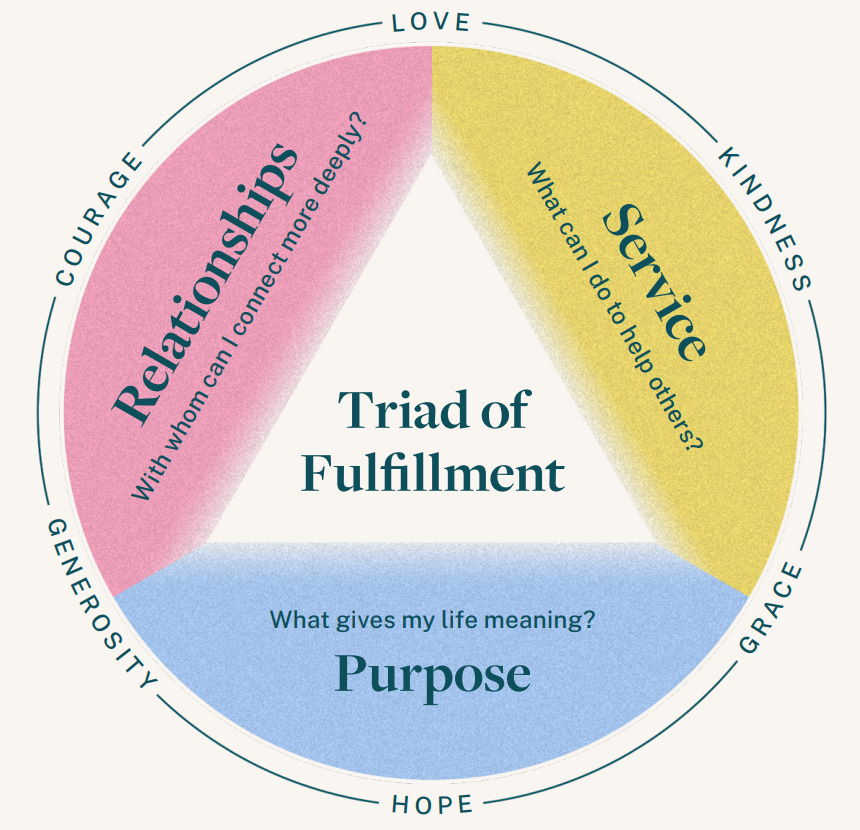
His argument is that, in order to live a fulfilling life, we’re all faced with an individual need to focus on these three main goals (all of which he argues aid us in forming community, ultimately). I can look at Murthy’s model and easily point to the ways that I live out the value of Purpose in my life. That’s the easy one. Service is, similarly, not a huge stretch for me. But in the category of Relationships, I would argue that many of us fall short.
How do you feel you’re doing with dedicating some portion of your life to helping others, some portion of your life to doing meaningful stuff, and some portion of your life to connecting more deeply with people you care about?
It’s not that I don’t want to connect deeply with others. I could point to plenty of people who are friends and acquaintances of mine—I love lots of people, and I know they love me! I’m sure if I reached out to any number of people right now, at 9:50 on a Friday night, they’d be glad to hear from me. I’ll bet they’d even reply right away instead of being annoyed that I was bugging them late at night.
Real-time update: As an experiment, I just sent random messages to ten friends, and that guess was right. Seven of the ten got back to me within just a few minutes, which is far more than I would have predicted. Everyone’s tired after a long week at work, and not everyone is as connected to their phone as I am. And yet those seven conversations, even just briefly checking in, all made me feel more connected, and seen, and known.
It doesn’t really make sense that hearing back from someone would make me happy, since getting a text from someone can actually cause stress (because then we have to muster up the energy to reply, right?) As Tanyel Mustafa says in her great essay, “I Can’t Reply to Your Long Text Message After Work”, when we’re exhausted from everything else that happened in our day, hearing from our friends is sometimes more than we can handle. I hate the fact that connecting in this way can add a sense of obligation to the people I care about, especially in this time when there are so many demands on our time and energy. I appreciated Mustafa’s suggestion that you give yourself the permission to leave that message unread until you have the spoons to read, process and get back to whomever sent it. And if you’re one of my friends who got a random text from me tonight (whether you got back to me immediately or not), I love you. Thanks for being in my life. I’m glad that I have (at least) seven people who put up with my nonsense tonight.
Dr. Murthy closes his Parting Prescription with these words:
What I want for my children more than anything is for them to be healthy, happy, and fulfilled. I now know that community is the key to securing this hope. It will provide them with meaning and belonging. It will allow them to give and receive the love and support we all require. It will be the source of strength and solidarity they will need to protect what is good about the world and repair what needs fixing. Community will always help them find their way home…As I finish my tenure as Surgeon General, this is my parting prescription, my final wish for all of us: Choose community.
I’m not sure how to solve my loneliness, any more than I’m sure of how to solve food insecurity or addiction or any number of other challenges that any of us face. But not being sure is different than not wanting to do better. And I want to do better. So I’m trying to choose community, even when I’m exhausted from all the things.
I dare you to text someone and tell them a joke, or send them a picture of a sandwich, or let them know you think they’re pretty cool. It’s worth it.
Take care, everybody. See you next week!
Great, great, GREAT piece, Matt. So true for so many.