
Tomorrow marks fifteen weeks since Kellie’s death. Fifteen weeks since every single thing in my life changed. Fifteen weeks since “normal” became “back then”. Fifteen weeks since I got to kiss my soul-mate. I know that I can be that exact with it, actually, because when I’d helped her up as she was taking that last walk down the hall, she hugged me and we kissed one last time.
I was chatting with a friend this morning about whether we have some kind of “grief print” that could be correlated to an individual if we had good enough data collection and number crunching abilities available to us. Yawns can be measured and differentiated between us, in the same way that gait and fingerprints and any other number of markers can show who we are on paper. So why not this?
I’ve told people for a long time “You grieve how YOU grieve, not how anyone else does.” I guess that backs up my friend’s idea about being able to quantify the contours of this thing in some measurable way. I knew that was true because I have seen, professionally, as many types of grief responses as I have had clients going through grief. No two experiences have looked identical to me, and that’s why it’s been so important for me to let my clients know that no, they’re not grieving wrong if it looks different from everyone else. They’re grieving like them. And I am certainly grieving like Matt grieves, which feels different than everyone else’s grief I have ever worked with in a whole bunch of ways.
After I made the comment this evening that it’s a big problem for us to look at a large data set and assume that we can apply what we learn from it to an individual’s life with any degree of accuracy, one of my students asked why we even gather data about things like life expectancy, then. I think it was a really good question, and one I spent a while considering with my class. It took us down a path of talking about probabilities and standard deviations and things, but also down a path of stigma and recognizing that individuals are individuals, they’re not fated to follow the path of the probabilities, and we do ourselves and those we serve a disservice if we assume anything is definitely going to apply to anyone.
I believe that, deeply. I believe that we all have the opportunity to succeed or struggle, to excel or fail (at that, at least). I believe that structural forces are often arrayed against some of us, and that matters of equity certainly make success much more difficult for some populations than others. I also believe, though, that grief is its own animal for each one of us, and that there isn’t any way to predict the color of that animal’s spots or how its fur will feel. I don’t think we can know whether it’s an ostrich or an aardvark until it happens to us.
But does it help for us to know the shape of someone else’s grief? I’m pretty sure that it does. I’m pretty sure that has been something which has helped me. I have walked alongside so many folks who have lost someone so dear to them that it felt like they were going to die too. And I’ve been there these last few months myself. So yes, that’s why I read other people’s stories. It’s why I listen to how other widowers are doing. It’s why I keep writing this, here, instead of just keeping it inside the journal for my private entries to Kellie. If you were wondering, I wrote my 61st letter only to her earlier this morning. I am glad to tell you about the shape of my grief if that informs you about some grief of your own, or about some truth about grief in general. If that’s even a thing.
I wish that I had learned some grand lesson about grief over these 105 days. I’ve learned a lot of things about my own grief, to be sure. But I haven’t learned anything about yours. Or at least I don’t think I have. I’m sure I’m learning things that aren’t consciously available to me, on some deeper level. And I wish there were things I could tell you that could help you weather this kind of storm on your own, if or when you have to do that. But I don’t want you to be prepared for something like this to happen to you. I really don’t.
105 days ago, the bottom dropped out of my entire world. I can still vividly remember the conversation I had with the head EMT in my hallway after she died. When he told me “Mr. Butler, I’m sorry—there’s nothing else we can do for her. She’s gone.” I remember repeating “Nothing? You can’t do anything? What do you mean she’s gone?” Over and over and over. I was stuck in those words like walking through knee-deep wet cement. I couldn’t move past them until he eventually patted me on the shoulder and said he was sorry again, and then physically walked away from me. It was just too enormous a truth for me to possibly be able to comprehend, then.
It’s been 105 days tomorrow, and I’m still exploring the contours of that truth. It’s still like a missing tooth in the back of my jaw that I explore, gingerly, gently, with my tongue when I feel brave enough. I can sit, now, and say aloud “Kellie’s gone” without having a panic attack. I can spend a minute thinking about how our Christmas Eve tradition of buying each other books and reading together while we drink hot chocolate in our new pajamas is over forever, and not completely lose my shit. I can tell the teller at the bank that my wife died in a casual conversation without needing to walk out or burst into tears. I can talk with the dogs about how Kellie bought them these treats, or this toy, without having to stop for a minute because it’s just too much.
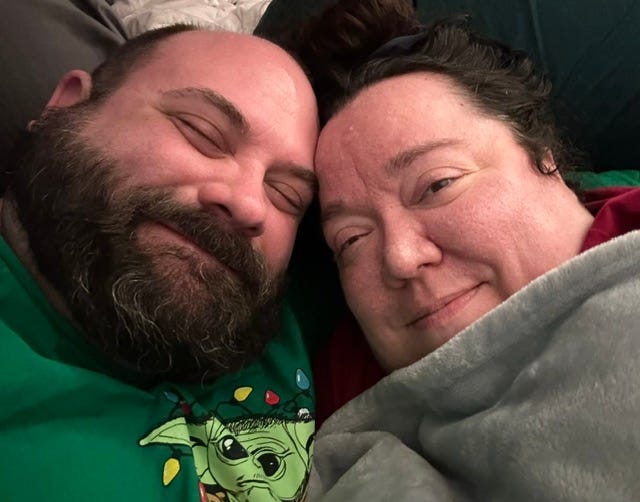
Does that mean I’ve mapped out my own personal grief print? Do I know what grieving like Matt looks like? I’m not sure yet. I’m pretty certain it’s going to be a lifelong thing for me, at least in a lot of ways. And I’m comfortable with that, which is a pretty new thing.
Right at the start of my loss, I couldn’t focus on the reality of the fact that I am going to miss Kellie for decades and decades (if I’m lucky enough to live that long). Just a little bit of that thought was enough to put me into panic mode, and that was overwhelming enough to make me shut down and move on to other thoughts. So that’s progress. I can accept the fact that I am going to be going through some flavor of this for the rest of my life, and that doesn’t make me freak out.
That said, the totally random grief storms do come from nowhere and overwhelm me for a minute or two at a time, still. That’s something which is common to lots of people, and I was expecting that one to show up. Well, it sure has.
I was sharing a song that I love with someone earlier today, and it turns out that song makes me miss Kellie an awful lot. That was a new one which really came from nowhere, since it didn’t give me that reaction last week when I listened to the same song. But today? So many tears (and audible ones) that Coco had to run over to me and hop up onto my lap to reassure herself that I was okay. She does that, and it really does help (even if that’s just a function of her distracting me for a second).
I would love to be able to say that I’m okay. I’m really not, no matter how many times I get asked that question. I don’t know what “okay” means for me, or what it’s going to mean for me eventually. I think that I’m past the point of my mood getting counted in minutes, if that gives you some indicator. I tend to have a good morning or a harder one, or a good evening or a more challenging one. So maybe that’s a bit of progress as well.
I’m really missing her tonight. Not in a sad way, or in a panicking way, or in a weepy way. Just in a nostalgic way. Like you’d miss your foot if it had been amputated, but you’d worked a long day and hadn’t had much reason to get up anyway, so you didn’t really think about your foot being gone until after supper when the sun started to go down a little bit and you got up to go for a walk and thought “Whoops, this walk is going to suck without that foot. I remember how awesome it was to have two feet. I wish I’d relished it more when I had two feet, instead of spending all that time lying down. I really should have gone on a TON more walks while it was still here.” You know—like that.
I sure wish Kellie was here.
Oh, and there go the tears.
Matt