
I write this piece one day before a crisis of unprecedented scope and scale drops into Ohioans’ laps (and the laps of everyone else in the country, too). I speak, of course, about the Republicans’ cynical, cruel and shortsighted choice to cut off funds to SNAP and WIC on November 1st. And when I say it’s a choice, I mean it’s a choice, not something that couldn’t be avoided.
You can argue that Democrats are to blame for the shutdown (they are) or that Republicans are to blame for it (they are, too). Our government was built around the idea of shared governance between opposing viewpoints, of checks and balances across the three branches and of oversight that tries to ensure we don’t end up with a monarch. That system and those safeguards are being sorely tested now, and depending on who you ask, we’ve gone far beyond the point of no return. I’m not planning on debating either of those points in this newsletter, as they’re bigger than what I can possibly fit into the scope of one week’s installment.
Suffice it to say that I believe the Democrats are holding the line on an incredibly important point of advocacy, since when healthcare costs skyrocket that is going to kill an awful lot of people in this country. And even though I support them in this effort, people are going to suffer as a result of it.
I shouldn’t have to point out to you (but I will) that Trump and the Republicans passed the One Big Beautiful Bill—which is going to vastly increase medical debt in this country—at the same exact time as a judge (with the support of this administration’s Consumer Finance Protection Bureau) ordered the rollback of the Biden-era policy that prohibited medical debt from being added to Americans’ credit reports. It’s almost like Trump and the Republicans want to further enrich the wealthy at the expense of everyone else…but that’s a topic for another newsletter, too.
Since this thing is titled What We Can, I’ll remind you that my whole intention from the start has been to try and help those who read it envision things that we can do (learning is doing too). Right now, everyday Americans are just about to go off the cliff of “barely making it” into the pit of “not even remotely making it”. And you—yes you—need to do anything you can to help those in need. That help needs to be real, not performative. It needs to be targeted. And it needs to focus on things that we know actually help people in need.
Let’s talk about the scope of the problem first.
November 1st is when the government says they can no longer pay out benefits for SNAP (also known as food stamps) in addition to other food assistance programs. The government shutdown plan from the USDA said that they would use their emergency funds to fund SNAP benefits anyway, until President Trump announced that no, that emergency fund wouldn’t be used since it’s not an emergency. It blows my mind to consider how heartless a person has to be to declare that everyone else can starve for all they care, but that’s exactly what’s happening.
What is SNAP? It’s one piece of our social safety net in the United States, that attempts to do a few things. First and foremost, the reason why it’s run by the USDA is because it was originally conceived as an assistance program for our farmers. The government purchases crops from farmers and distributes them out to those in poverty, and everyone wins, right? It’s also a way to stop people from starving, which is a good thing (we all used to agree on this point).
This is a really good piece from USA Today about the folks who are about to be most harmed by the cutting off of these funds.
Who is eligible for SNAP benefits?
The Center on Budget and Policy Priorities says that for a household,
Its gross monthly income generally must be at or below 130 percent of the poverty line, or $2,798 a month (about $33,576 a year) for a three-person household in fiscal year 2025. Households with a member who is age 60 or older or has a disability need not meet this limit.
Its net monthly income, or income after deductions are applied for items such as housing costs and child care, must be less than or equal to the poverty line ($2,152 a month or about $25,824 a year for a three-person household in fiscal year 2025).
Its assets must fall below certain limits: in fiscal year 2025 the limits are $3,000 for households without a member who is age 60 or older or has a disability and $4,500 for those with an older or disabled member.
So we aren’t talking about incredibly wealthy folks here. We’re referring to people who are struggling more and more to be able to afford enough food to survive, especially given the fact that food prices just continue to rise under this administration. And beyond income level, what’s the breakdown of the types of people that SNAP supports? CBPP continues,
Data from the U.S. Department of Agriculture show that nearly 80 percent of participants are in households with a child under age 18, an adult age 60 or older, or an individual who is disabled.
So households with kids, older adults, or those with a disability, pretty exclusively. The USA Today article shares this age breakdown, if you wanted a more granular look at specific groupings.
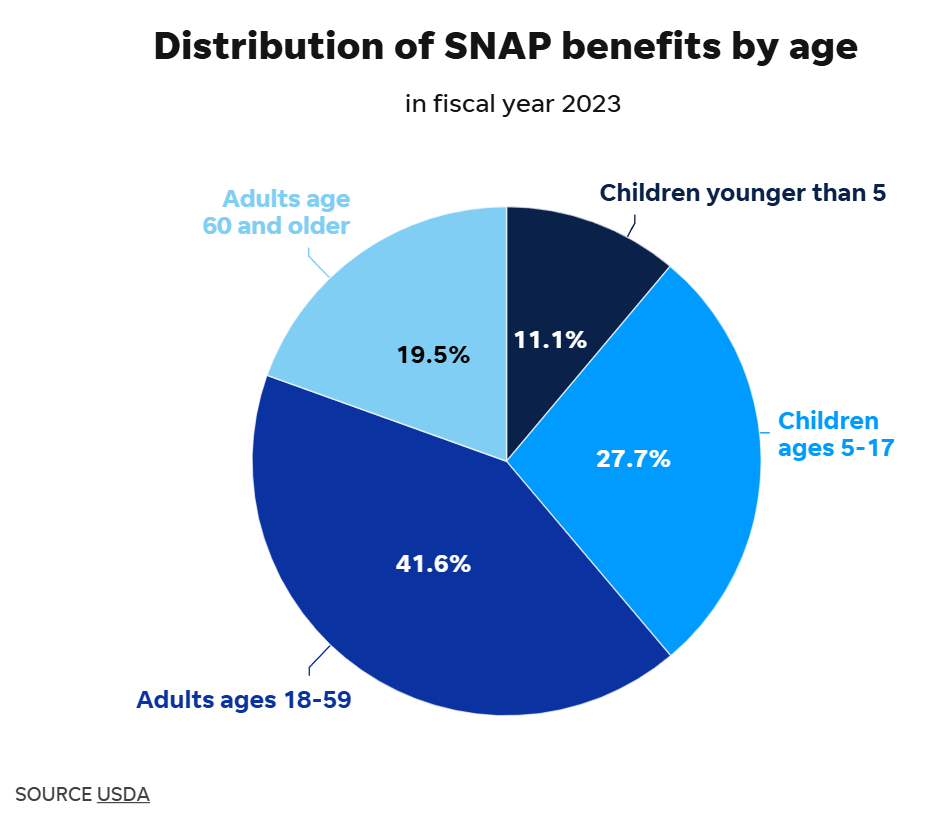
You can see that children from 0-17 make up almost 40% of SNAP benefits. And those are getting frozen on Saturday, regardless of the Republican narrative that “you can just go out and get a job”. How many five-year-olds do you know who are working full-time jobs to be able to afford food to avoid starvation? Yes, the Republicans are increasingly advocating for an end to the ban on young children working, since they don’t really seem to recognize the benefits of a healthy and happy childhood that’s spent not worrying about paying rent and buying food. As this PBS article shares, Republicans in at least ten states (including Ohio) have advocated for allowing kids as young as 14 to work in hazardous environments and to serve alcohol in bars.
Project 2025, the Republican playbook that has been followed to the letter by the Trump Administration, mentions quite a bit about their intent and desire to overturn the Fair Labor Standards Act and allow minors to work in all kinds of dangerous places. This piece quotes the US Dept. of Labor in saying, “Since 2019, there has been an 88 percent increase in cases where children were found to be employed in violation of child labor laws.” They also note,
Recent cases, such as a 16-year-old boy in Wisconsin who died working in a sawmill after he became entangled in a machine, and another teenage boy in Pennsylvania who died after getting pulled into a woodchipper on a worksite, are tragic examples. In addition, despite fatalities, the DOL continues to identify children working in slaughterhouses and meatpacking facilities, long considered hazardous occupations not safe or suitable for minors.
Is this the America you want? A country where our children go hungry and/or work in sawmills and bars? It’s the America Donald Trump wants, and apparently the America many of his cronies want as well.
So despite the fact that we have billions of dollars which could be used to make sure that nobody goes without food stamps, this administration has chosen not to use the emergency money for this emergency (in an attempt to pressure the Democrats into allowing them to continue doing anything they want).
But guess what? Luckily, individual states are taking action to make sure their children, older people, and disabled folks don’t starve to death. That’s fantastic! In the absence of federal leadership or will to save those lives, plenty of states, run by both parties, are stepping up to make a difference.
Here’s a map from Newsweek and CBBP that shows the states that are not sitting around and waiting to see how many people need to suffer from food insecurity TWO DAYS FROM NOW.
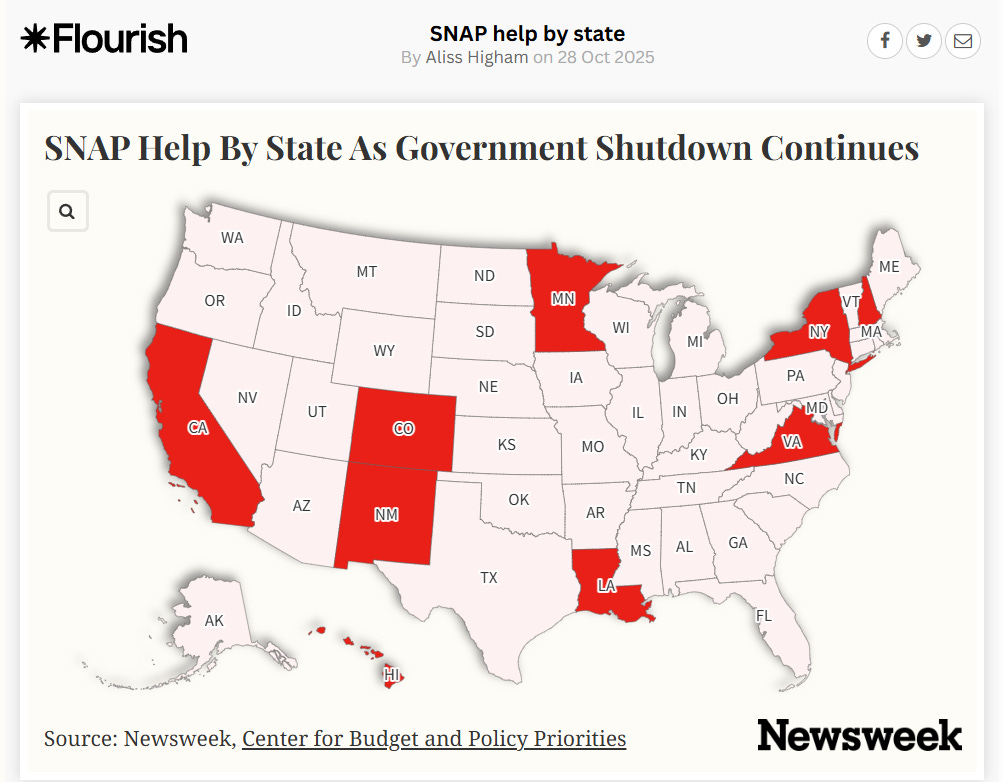
You’ll notice one state conspicuously missing from that map (I say conspicuously because this newsletter primarily addresses Ohio-centric issues). Yes, this state has chosen to let our citizens starve. Let me be very specific: elected Republicans in Ohio have chosen to let our citizens starve.
Here, from AmericanProgress.org, is a chart of which counties in Ohio have the most residents who rely on SNAP benefits:
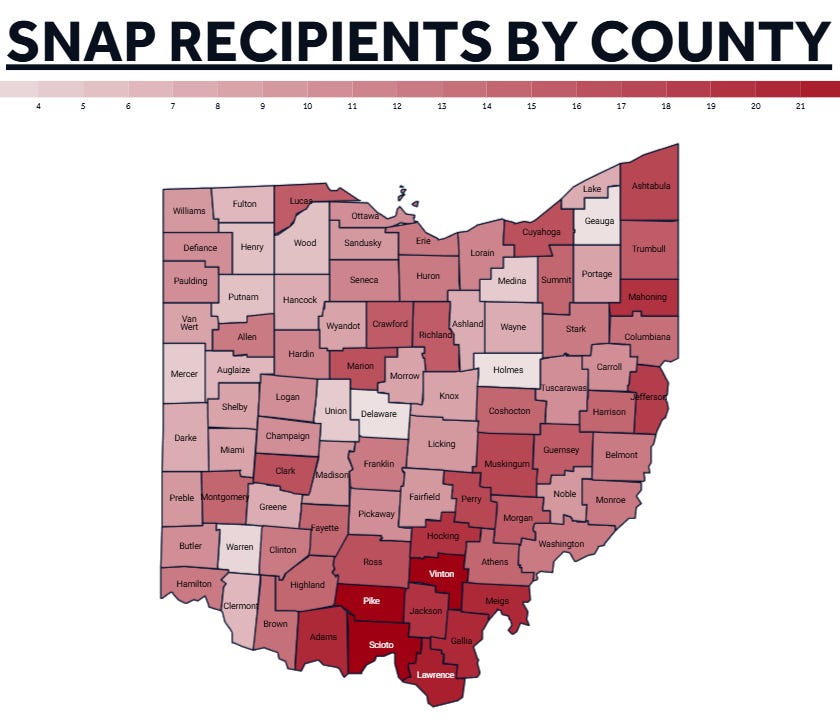
Ashtabula County, if you were wondering, has 17,221 SNAP recipients out of our 96,987 residents, or 17.8% of our population. That’s far higher than much of the state, though there are 1.5 million Ohioans currently receiving SNAP payments.
Elected Ohio Democrats have been trying to convince the Ohio GOP to use the state’s savings (the “rainy day fund”) to cover this vital food expense once SNAP payments from the federal government stop on the 1st. And what has been the response from our elected Republican overlords?
Here’s just a sample:
This week, Governor DeWine said we can’t use the Rainy Day Fund, but that he’s “reviewing and monitoring the situation”.
Matt Huffman (the Speaker of the Ohio House) responded to the Dems’ proposal to give state money to food pantries by saying “We do have food banks, but those aren’t necessarily tailored just to the folks who get SNAP benefits…There’s not the same income verification system, things like that.”
Jerry Cirino (the Republican Ohio Senator who’s dedicated the last few years to ending indoctrination from woke college professors instead of anything that might help a single Ohioan), said “It’s appalling because it fails to recognize why we have this problem, why we are in this fix in the first place, and where the solution lies. It’s not the federal government, it’s not the White House, it’s not the Congress in total. It’s the (U.S.) Senate Democrats, except for one. They lit this fire, and now they want us to bail them out and put out the fire.”
The Ohio Dems proposed an amendment to the budget bill today that would have allowed the state to use those 4 billion dollars in the Rainy Day fund to help Ohioans who are about to be cut off from SNAP and WIC. And it was immediately blocked on a party line basis, as every Republican opposed that proposal. Because almost 1.5 million Ohioans don’t deserve to be able to eat. I can’t get over Huffman’s argument that that people can’t be be given food assistance because—what—they’ll lie to get some free pasta and soup? And Cirino’s statement is in incredibly poor taste. The problem is not the Democratic Party—the problem is that Ohioans are going to go hungry, and the Republicans hold all the cards in this state at the moment due to their unconstitutional and illegal gerrymandered districts.
Update: I wrote the bulk of this newsletter last night, and in fairness’ sake need to point out that Ohio Governor Mike DeWine signed an executive order today promising up to $25 million to Ohioans who will be affected by this benefits freeze. That is a massive drop in the bucket, but it’s SOMETHING. It’ll be distributed in the form of $7 million to food banks and up to $18 million to Ohioans who are below 50% of the federal poverty limit. Keep in mind how few people that $18 million is likely to help (50% of the federal poverty limit means that they have income below $978 per month for a family of one, which pretty much ignores all of the working poor in this state.) At least it’ll count for everyone living off SSI, since that benefit is $967 per month for an individual. But still. The vast majority of Ohioans on SNAP benefits make more than a thousand dollars per month and are going to be ineligible for those $18 million.
I’m definitely happy that the state is using $25 million to try and help in this situation. It’s only .625% of the $4,000,000,000 rainy day fund that the state has for just such an emergency, but it’s something.
It’s inhumane, pure and simple. Cruelty for cruelty’s sake. And it’s just plain wrong.
Do you think that people get food stamps for their entire lives? That’s far from the case. This is an extremely temporary program for most people, which steps in when they’re in the direst of straits. Back to that CBBP article for a source on the numbers:
Most unemployed non-disabled adults aged 18 to 54 not living with minor children are limited to three months of benefits every three years, unless they are working at least 20 hours per week or participating in a qualifying workfare or job training program.
That’s right: three months of food stamps, unless you’re working, have a disability, or are a child or senior.
Also, it’s not a whole lot of money. You’ve probably seen some of the TikToks from people (usually people of color) acting offended at the suggestion that they work and saying they are getting hundreds or thousands of dollars per month for their ten kids. They’re fake videos, folks. It harkens back to the racist “welfare queen” trope from the Reagan years, and just like those stories, they’re made up. If you were wondering, that CBPP article actually tells us how much people get:
On average, SNAP participants will receive an estimated $187 per month (or about $6.16 per day) per person in regular SNAP benefits in fiscal year 2025.
When was the last time you and your family only spent $6.16 per day per person on your food budget? Especially now, with today’s food prices? Nobody’s getting a million dollars in food stamps.
This program is incredibly important, and Republicans have effectively cut it off starting this Saturday.
So your elected politicians are probably not going to help those in need in your community. I’m sorry it’s that way. It shouldn’t be the case. But they have decided not to care. That means it’s up to us.
And here’s where we talk about how we can make a difference. I present to you, below, a list of some things you can (and really should) do to make an impact. And you need to do them now, not days or weeks or months from now. Now.
What Can We Do?
As I said earlier, our efforts need to be concrete, targeted, and geared around strategies that we know actually help people. So a few thoughts:
Posting on Facebook (or Instagram, or TikTok, or Twitter, or Snapchat) doesn’t do much good to anyone who is in need of food and other resources. If you want to use your platform to try and change minds, do that—keep in mind, though, that performative measures like this might make you feel better but do not actually help hungry people.
Targeted strategies, leveraging larger groups of people in terms of both those helping and those getting the help, make much more sense than you donating a few dollars to a national organization. Mutual aid can be really important in trying times, and these are trying times. So look for a community of likeminded folks who you can combine your efforts with, and contribute to the need that exists within that community.
There are already food pantries and soup kitchens and churches and homeless shelters in your area. There are already Community Action agencies and 211 and Catholic Charities in your community. There are already people (you may even know some of them) who are experts at collecting funds, distributing food and other aid, and figuring out those who need it most. Why on earth would you reinvent the wheel?
If you are planning to donate to an organization, do a little homework first. Are they already at a pretty good place, financially-speaking? Maybe look for a smaller church or community center or agency that is likely to need the help more due to having a smaller budget to begin with.
Consider the fact that money is always in short supply, but volunteers are usually even harder for nonprofits to come by. If you have the physical and mental ability to donate some of your time, and enough energy to do so, there are probably several dozen organizations that would LOVE to have you spend a few hours with them and helping others in a very concrete way.
Do you have any extra food yourself? What about offering to share it with someone you know has less? In the spirit of mutual aid, maybe you could arrange a skillshare—I’ll bet that you could help someone else who has talents that might help you in your life. Why not trade?
I realize that I already said that posting online is probably a waste of your time and effort, and is mostly just performative. All of that is true—but also, there are a small but extremely loud contingent of people who are determined to dehumanize and mock and cheer for the starvation of their fellow humans. When you see those people excited at the fact that people in their neighborhood will soon be struggling to stay alive, SAY SOMETHING. PUSH BACK. Make clear that hatred toward those living in poverty is unacceptable to you, and help to make that the norm in the online spaces you frequent.
You can look on Facebook pages and websites for your local United Way, or call 211 or your local Community Action Agency, or just do a Google search—anything—to find existing agencies that are already publishing lists of food pantries and how to access them. Download, screenshot, and share those lists with anyone in your life who is struggling.
There are likely to be many individuals, in the imminent future, who are unaccustomed to seeking out assistance from strangers but are otherwise going to struggle to have enough food to eat for themselves and their families. Normalize their situation, treat them with kindness and compassion, and help them.
Don’t forget that there are also lots of marginalized individuals (such as many of those in the LGBTQ+ community) who might be reluctant to seek out help from religious-based nonprofits due to their history of religious trauma. If you’re donating time or energy or money, please try to seek out those organizations who provide specialized resources to those who come from these communities.
On the topic of marginalization, undocumented folks were already generally ineligible for SNAP benefits. With the current climate of hatred and fear surrounding those who have entered this country in this way, they need a whole lot more help than usual. Also keep in mind that organizations that have been helping undocumented immigrants in the past are going to be stretched to their limits by this new crisis, so they’re in even more need of help than ever before.
And while we’re talking about immigrants, there are millions of refugees and documented immigrants in this country who have nothing to do with the current fervor and bigotry surrounding the immigration debate—but who are still bearing the brunt of all that fervor and bigotry. Don’t forget that they need a whole lot of support as well.
Advocacy makes a difference, too. Call and write to your elected officials. Make life uncomfortable for them until they do something about this, and at the very least don’t let them pretend that a little bit of help is all they need to offer (when they have the power to do much more than that).
As I said, this could never be an exhaustive list of every possible thing you can—or should—do to help those who are now on the verge of starvation due to the heartlessness of a few elected officials. I’m not trying to tell you what you have to do. I am, however, telling you that you have to do SOMETHING. What you do is up to you, but you’re going to think back on this time five years or ten years or twenty years from now, and you’re going to have to rationalize to yourself why you chose to do nothing. And none of those reasons will be good enough. What you can do, now, right now, is help. All of us have that obligation.
I’m hosting an impromptu meeting of a bunch of social work students from my program tomorrow. They’re begging for suggestions of things they can do to make a difference in the coming crisis, so I have provided time and space for them to brainstorm with each other and come up with a plan. My students are not wealthy. They’re mostly in their 20s and 30s, with some of them as young as 18 and some as old as their mid-60s. They’re from rural backgrounds, mostly, and the majority of them are the first ones in their families to go to college. But they want to organize amongst themselves, and they want to make a positive impact. I’ll keep you updated on what they decide to do, but I’m thrilled to see what they come up with and play some small role in their plan.
Figure out what you can do, and do it. That’s the assignment. Talk to you next week.
Matt, I think you mean it’s about 4 Billion in the state’s rainy day fund, not Trillion. Think about it.